About this Release
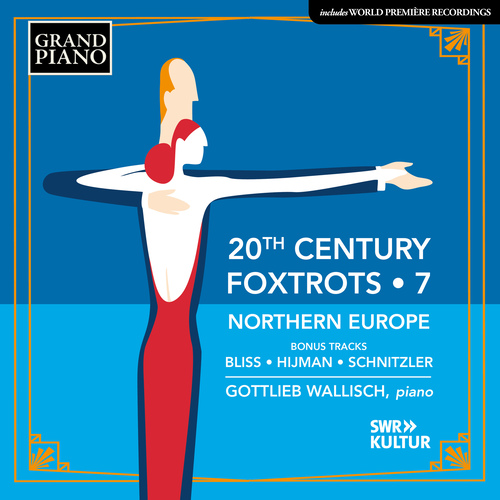
20TH CENTURY FOXTROTS • 7
Northern Europe – Bonus Tracks
- Gottlieb Wallisch, piano
Gottlieb Wallisch’s seventh and final volume in this acclaimed series features many unknown gems. The complete album 20th Century Foxtrots • 7: Northern Europe is available on CD (GP950), and for download and streaming. This digital EP features bonus tracks by English composer Sir Arthur Bliss, and world premiere recordings of pieces by Dutch composers Louis Schnitzler and Julius Hijman.
Tracklist
|
Bliss, Arthur
|
|
1
Bliss one-step, F. 138 (1923) (00:02:58)
|
|
2
The Rout Trot, F. 144 (1927) (00:02:41)
|
|
Schnitzler, Louis
|
|
3
Tango (1933) (00:03:06)
|
|
Hijman, Julius
|
|
4
Piano Sonatina: II. Blue (1936) (00:03:23)
|
The Artist(s)
 Gottlieb Wallisch has performed on stage at the world’s most prestigious concert halls and festivals: Carnegie Hall New York, Wigmore Hall in London, the Cologne Philharmonie, the Tonhalle Zurich, and the NCPA in Beijing, also the Ruhr Piano Festival, the Beethovenfest in Bonn, and the Festivals of Lucerne and Salzburg. Conductors with whom he has performed as a soloist include Sir Neville Marriner, Dennis Russell Davies, Kirill Petrenko, Martin Haselboeck and Bruno Weil. Orchestras he has performed with include the Vienna Philharmonic, Royal Liverpool Philharmonic, Frankfurt Radio Symphony, Franz Liszt Chamber Orchestra Budapest and the Stuttgart Chamber Orchestra. He has made numerous recordings for record labels, including Naxos. Gottlieb Wallisch is a Steinway Artist.
 The Composer(s)
Also Available

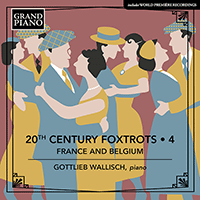
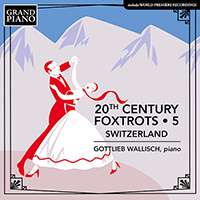
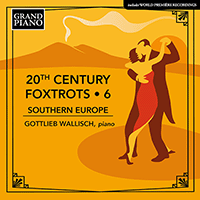
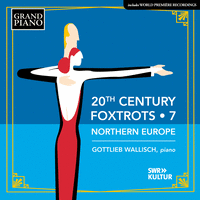
 Grand Piano has gained a reputation for producing high quality recordings of rare keyboard gems. Dedicated to the exploration of undiscovered piano repertoire, the label specialises in complete cycles of piano works by many lesser-known composers, whose output might otherwise have remained unknown and unrecorded.


- info@grandpianorecords.com