
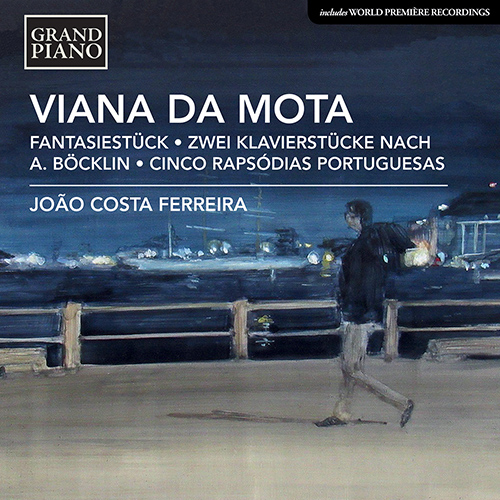
About this Release
“It was a great pleasure for me to confront the challenge of Viana de Mota's pianistic virtuosity in this album. My own Portuguese origins helped me to understand and to interpret the many different and complex emotions expressed in these piano compositions influenced by the German tradition and the discovery of Portuguese folk music.” — João Costa Ferreira
VIANNA DA MOTTA, JOSÉ (1868–1948)
Piano Works
- João Costa Ferreira, piano
Among the first works composed in Berlin by the young José Viana da Mota were the Fantasiestück, Op. 2, brimming with Schumannesque cantabile, and the more fiery, Liszt-inspired Zwei Klavierstücke nach A. Böcklin. Written when the composer had established himself as one of the great virtuoso pianists of the Liszt school, the Rapsódias Portuguesas draw upon native fado tunes, religious and love songs and children’s round dances to create a vivid and idealised mosaic of Portuguese national identity.
This recording was made on a modern instrument: Fazioli Grand Concert F278 Series, 2780413
Tracklist
|
1
Fantasiestück, Op. 2 (c. 1884) (00:07:29)
|
|
2 Klavierstücke nach A. Böcklin () (00:09:10 )
|
|
2
No. 1. Meeresidylle * (00:04:48)
|
|
3
No. 2. Im Spiel der Wellen * (00:04:19)
|
|
5 Rapsódias Portuguesas (5 Portuguese Rhapsodies) (1895) (00:41:45 )
|
|
4
No. 1 in G Major, "Fados" * (00:11:28)
|
|
5
No. 2 in A Major * (00:06:21)
|
|
6
No. 3 in D Major * (00:07:28)
|
|
7
No. 4 in A-Flat Major, "Evening Prayer" * (00:07:00)
|
|
8
No. 5 in F Major, "Saint John's Day" * (00:09:09)
|
The Artist(s)
 Director of the Maison du Portugal André de Gouveia at the Cité internationale universitaire de Paris, João Costa Ferreira is a Portuguese pianist and researcher who holds the prestigious Diplôme supérieur d’exécution from the École normale de musique de Paris, and a doctorate in music and musicology from Sorbonne Université. He began his piano studies at the age of eleven at the Orfeão de Leiria – Conservatório de Artes with Luís Batalha. At 19, he left for Paris where he studied with Marian Rybicki and Guigla Katsarava, and became a pupil and assistant of the pianist Jean Martin. He went on to do his doctorate under the direction of philosopher and musicologist Danielle Cohen-Levinas, supported by a scholarship from the Fundação para a Ciência e a Tecnologia.
 The Composer(s)
 Born in the Portuguese African colony of São Tomé, José Viana da Mota (1868–1948) started out as a child prodigy, performing on the piano at the age of six for Fernando II, a prince of Saxe-Coburg. Viana da Mota achieved worldwide recognition as one of the leading exponents of the Lisztian piano school, both as a concert soloist and as a chamber musician collaborating with such distinguished partners as fellow pianist Ferruccio Busoni, violinist Pablo Sarasate and soprano Marcella Sembrich. He also enjoyed a brilliant teaching career at both the Berlin and Geneva conservatories, and in 1917 the Portuguese government appointed him head of a committee charged with reforming the teaching programme and methods of the the Lisbon Conservatory, of which he then became Director two years later. For the next three decades he was responsible for training several of the most acclaimed Portuguese pianists of the generations.
 Also Available

 Grand Piano has gained a reputation for producing high quality recordings of rare keyboard gems. Dedicated to the exploration of undiscovered piano repertoire, the label specialises in complete cycles of piano works by many lesser-known composers, whose output might otherwise have remained unknown and unrecorded.


- info@grandpianorecords.com
